Hope 4 Partners
Online support for partners of people living with acquired brain injury (ABI)
HOPE4Partners is an online course for partners of people living with acquired brain injury (ABI), developed as part of a research project at Coventry University. It provides a safe and supportive space where partners can understand and adapt to changes in their relationship and everyday life following brain injury.

What is Acquired Brain Injury?
It all begins with an idea. Maybe you want to launch a business. Maybe you want to turn a hobby into something more. Or maybe you have a creative project to share with the world. Whatever it is, the way you tell your story online can make all the difference.
Feasability trial
We have worked with people living with ABI to co-design a new online self-management programme to support mental and sexual wellbeing after brain injury. The programme is called ‘HOPE4ABI’.
HOPE4ABI is an 8-week online course, that can be accessed at times to suit you, so you can work through at your own pace. The programme focuses on support with managing wellbeing, relationships & intimacy.
We delivered two courses as part of the trial from October 2023.
The protocol below describes a feasibility randomised controlled trial of HOPE4ABI, a digital self-management programme to support mental and sexual wellbeing, co-designed with and for people with ABI.
Publication: Wright, H., Walker-Clarke, A., Drummond, A. et al. Self-directed versus peer-supported digital self-management programmes for mental and sexual wellbeing after acquired brain injury (HOPE4ABI): protocol for a feasibility randomised controlled trial. Pilot Feasibility Stud 9, 194 (2023). https://doi.org/10.1186/s40814-023-01421-z
Further research
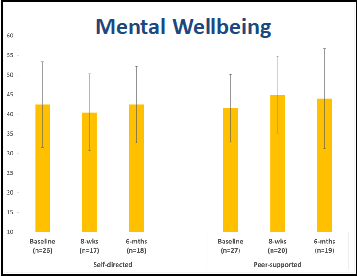
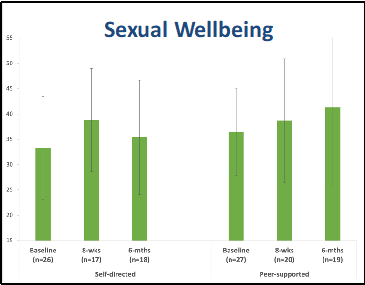
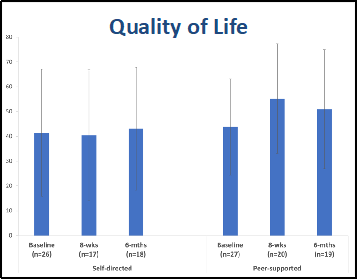
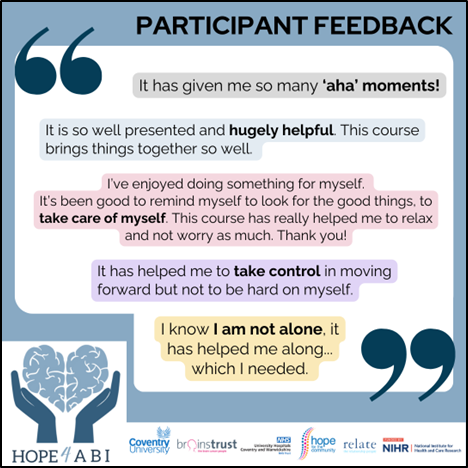
Our pilot study showed that HOPE4ABI is helpful and acceptable for a range of people living with stroke and brain injury. Here are a selection of quotes from our study participants after taking part in the 8 week course:

“It helped me understand what has happened to me”
“I’ve not had much help with outside agencies, as no one does it all. This course has covered everything … [and] is something we can do on our own”
“It was very helpful to get all the information in one place. This [course] has been the only place that I have found clear advice on symptoms”
For further information contact the HOPE4ABI Research Team lead: Hayley.Wright@coventry.ac.uk